Supported by:


This intercropping field lab was run as part of the Horizon Europe LEGUMINOSE project (Legume
cereal intercropping for sustainable agriculture across Europe) project with UK funding from
UKRI. Run over three years, the on-farm trials in this field lab compared yield and crop
quality between neighbouring monocrops and intercrops.
Intercropping is an ancient agricultural technique where two or more plant species are grown simultaneously in the same field. Despite its environmental and economic benefits, intercropping is still a niche practice in the EU: Only 2% of European arable land is used for legume-cereal intercropping.
This project is funded by Horizon Europe. UK funding is provided by UKRI. The project brings together a partnership of 17 organizations from around Europe. UK partners are Reading University and Soil Association. For more information see the LEGUMINOSE project description in the results and reports section of the field lab page.
The UK on-farm intercropping trials have indicated that total field yield increases when
intercropped, with increases in grain protein and a reduction of pest and disease risk. The
increased protein yield from the field can be useful in a livestock system by producing a
home-grown ration.
Intercropping is not a new technique but remains a niche activity. The LEGUMINOSE project
is looking at the potential to increase its use by looking at some of the barriers which reduce
uptake and exploring some of the opportunities for expansion.
• Increased yield of around 20% in total crop yield and also increases in yield of
individual components of the intercrop when compared with the equivalent area of
cereal.
• Reduction in disease and pest issues, reducing the need for chemical intervention
• Addition of nitrogen fertiliser reduced the benefit of intercropping.
• Alternate row planting led to higher pulse yield which is of interest when growing
pulses for premium markets.



In this film, farmers share their real-world experience of growing legumes and cereals together through intercropping, plus improving marketing opportunities for these products. Discover how intercropping can help reduce weed pressure, lower reliance on herbicides and fungicides, improve harvestability, support soil health and increase whole-farm resilience.
You'll hear practical advice on getting started, overcoming separation and marketing challenges, finding routes to market, and whether investing in on-farm separation equipment can help unlock greater value from your crops.
Whether you're looking to improve profitability, reduce risk, strengthen your rotation or explore regenerative farming practices, this video offers honest insights from farmers who have made intercropping work on their farms.
This film was produced by the Soil Association as part of LEGUMINOSE, a Horizon Europe-funded project exploring how legumes can help build more resilient, profitable and sustainable farming systems. UK activities are supported by UK Research and Innovation (UKRI). The project brings together 17 organisations from across Europe, including the Soil Association and the University of Reading. This work has received funding by UK Research and Innovation (UKRI) under the UK government’s Horizon Europe funding guarantee [grant nos 10057156 and 10039837] to the Soil Association and the University of Reading.
Views and opinions expressed are however those of the author(s) only and do not necessarily reflect those of the European Union or European Commission. Neither the European Union nor the granting authority can be held responsible for them.
Watch the film online here: How to grow your profits with intercropping and make your farm more resilient - YouTube
Discover how cereal-legume intercropping can boost farm resilience, protein production and nature friendly farming.
Join us to hear learnings from the Horizon Europe LEGUMINOSE project, including the potential for cereal/legume intercropping to provide on-farm resilience by improving UK production of protein with potential uses for livestock and human consumption markets, and supporting nature friendly farming.
Intercropping is an ancient agricultural technique where two or more plant species are grown simultaneously in the same field. Despite its environmental and economic benefits, intercropping is still a niche practice in the EU: Only 2% of European arable land is used for legume-cereal intercropping.
The on-farm trials, and the LEGUMINOSE project (https://www.leguminose.eu/) have been investigating the benefits of intercropping, identifying the barriers which prevent farmers adopting the practice, and providing farmers with practical, science-based information to support decision making. Find out more about the LEGUMINOSE UK on-farm trials at Innovative Farmers: https://www.innovativefarmers.org/far...
LEGUMINOSE is a Horizon Europe funded project, with UK funding provided by UKRI, investigating plant interactions in a cereal and pulse intercrop, and working with farmers and stakeholders to remove barriers to adoption of intercropping. For more information on LEGUMINOSE see the project website: https://www.leguminose.eu/
Speakers and panellists:
Jerry Alford - Senior Farming Advisor, Soil Association
Matt England - Farmer and trialist
Professor Tom Sizmur - Associate Professor, University of Reading
Watch online here: Webinar: Boosting farm resilience through cereal-legume intercropping - YouTube
Watch the video of farmer Dougal Hosford sharing his experience with the LEGUMINOSE project
Watch the video online here: (37) Why This UK Farmer Is Changing How He Farms - YouTube
An event at Waitrose's Leckford Farm, with a free farm walk and speakers sharing the outcomes of trials growing legume/cereal intercrops. The latest field lab results will be available soon.
A key barrier to the uptake of intercropping is a lack of knowledge about its agronomy, specifically around weed and pest control but also species selection and seeding ratios. In this webinar, we hear from experts on the topic, plus learn the latest insights from the LEGUMINOSE intercropping field lab.
The 2024 results reveal clear benefits for the practice, including improved nitrogen levels, reduced pest damage, and greater resilience, making intercropping a practical and profitable option for arable farming.
For full results please see the reports and results section of the page by clicking on the brown banner above.
Or go to the article on our news section:
This research is part of the Horizon Europe LEGUMINOSE project.
In October 40 farmers, researchers and supply chain actors met at to hear the latest research findings from the UK LEGUMINOSE intercropping trials. The day included a presentation from Dougal Hosford, a trialist sharing his experiences, discussions around market opportunities for intercrops, and a tour of Alvan Blanch's facilities to explore post-harvest separation options.
Read about the 2024 results: Farmer led results show the benefits of intercropping
Farmer insights - Dougal Hosford’s intercropping experience 2024
Dougal Hosford joined the LEGUMINOSE trials to explore intercropping as a strategy to regenerate his thin, chalky Dorset soils and test direct drilling. While combining the intercrops was challenging, he found it manageable and a valuable learning experience. Growing winter wheat and beans together, he noted a poor bean yield, likely due to competition from the wheat. An attempt to establish clover as an understory also fell short, only sprouting the following year.
Dougal found that barley and peas provided the best margins, reducing risk in unpredictable weather. Reflecting on his experience, he recommends farmers new to intercropping start with a “clean field” to manage weeds. For Dougal, intercropping has been about finding the right balance to maximise margins, not just yields.
Intercropping market insights from Hodmedods
Hodmedods, pioneers in UK-grown pulses and grains, see intercropping as fundamental to a resilient, agroecological food system. Crop mixtures offer soil benefits and flexibility, connecting feed and human consumption markets. Wheat serves as an ideal secondary crop, providing a backup market.
Still, they acknowledge that intercropping has its hurdles. For instance, lentils, which can be prone to low growth and weed competition, benefit from being grown with Camelina, which offers structural support. Pea and barley intercrops should use yellow peas for human markets, as green peas can bleach, affecting visual quality.
Post-harvest separation remains challenging, particularly with allergenic crops like mustard. Shared equipment could help, but the right setup requires collaboration and trust between farmers and buyers. Consumer interest in environmental benefits means intercropping stories are valuable for connecting with markets.
Hodmedods continues to innovate by introducing heritage grains and new legumes to the UK market, linking soil health to consumer demand. They see intercropping as a bridge to a more diverse, sustainable food system that aligns with consumer priorities around health and the environment.
Options for separating intercrops post-harvest
Seen as a barrier to intercropping, separation of the 2 crops was demonstrated at the event with equipment manufactured by Alvan Blanch on the factory tour. Options include normal on farm cleaners through separators using gravity tables to create multiple crop samples to more complex systems separating by colour.
What’s next for the LEGUMINOSE intercropping trials?
The trial continues. Farmers interested in taking part in trials on intercropping for 2025 harvest are invited to contact the trial coordinator Jerry Alford. If you have an idea you’d like to test, such as winter intercrops or growing in strips , get in touch with Jerry Alford at jalford@soilassociation.org.
The trial plot was planted in April 2023 as part of a whole field of intercropped beans and wheat. Although not organic, the plot was not treated with any herbicides or fungicides due to the requirements of the contracted purchaser.
The wheat was a 3-way blend of varieties, and the beans were lynx. Drilling rate was based around 60% of normal farm seed rate, with the same rate for the trial area.
Harvest was 19th August with grain samples taken from the combine and combine yield monitor used to record yield. Beans and wheat were separated out for analysis.
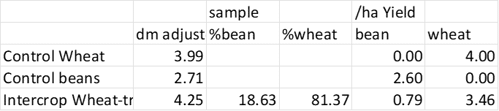
The intercropped area produced 6% more total yield with a Land Equivalent ration of 1.16.
Wheat Quality-the wheat from both monocrop and intercropped plot were tested for protein with the following results.
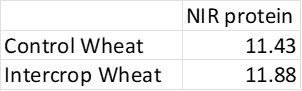
Although not to milling specification, the intercropped results show that intercropping can lead to increases in grain protein. The combined wheat and bean mixture had a protein level of 14%
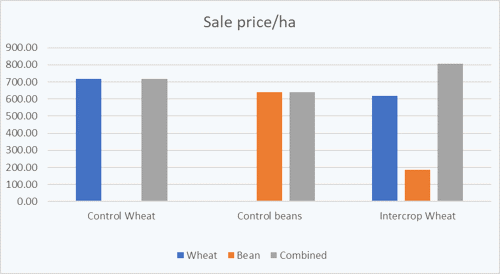
Economics-Sale price has been calculated based on Farmers Weekly price for non-organic crops on 18/12/23 with ex-farm prices of £179.33 for wheat and £236.08 for beans. Cost of separation and additional seed not accounted for.
Weed and Pest levels
Weed levels appeared higher in the monocultures, particularly phacelia which had self-seeded from a neighbouring cover crop margin. There was no phacelia in the intercrop plots, but small levels in both the wheat and beans although not at levels likely to affect yield.
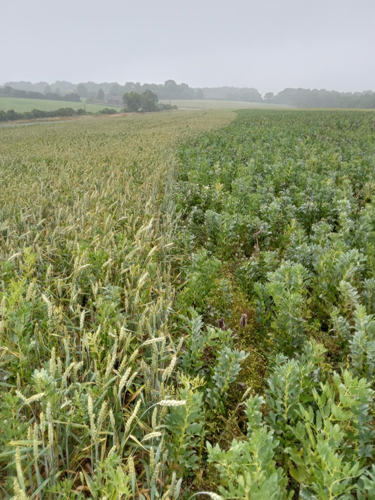
There appeared to be a lower level of Bruchid beetle damage in beans from the intercropped section compared to that from the bean monoculture. There was more evidence of damage in a nearby whole field bean monoculture.
Conclusion
The evidence from this trial is that intercropped mixes do increase net yield and the increases in protein level do indicate that there is a synergy between both species. The anecdotal evidence from the trial will be investigated further during the Leguminose project. We are still looking for more people to be part of the trial.
Separation or marketing of the crops is important area to investigate.
View the latest webinar recording:
In June farmers, researchers and supply chain actors came together to see intercrops on an arable farm in Oxfordshire and to explore barriers and opportunities to intercropping. Read about the day in our reports and results section, by clicking on the brown banner above.
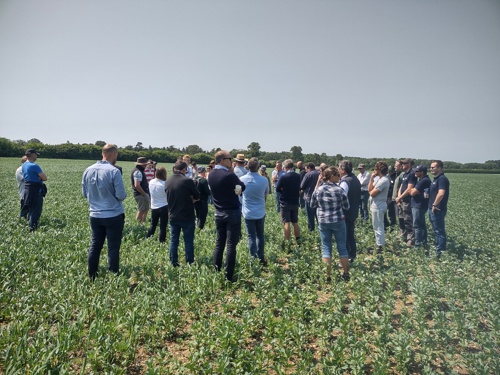
Last week over forty farmers and researchers met at a farm workshop in Oxfordshire to share their experiences of intercropping, as part of the European project LEGUMINOSE. The event was kindly hosted by Ben Adams, who is in the middle of his own intercropping trial.
Please see the event blog for further information
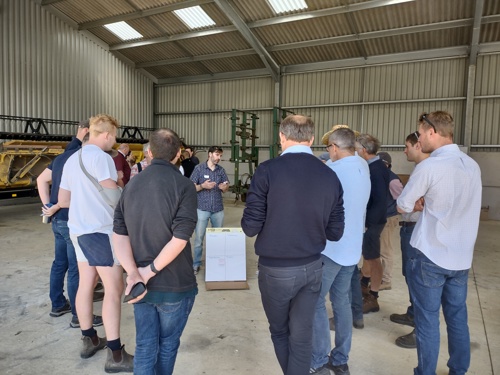
The next LEGUMINOSE farm workshop will be held in the autumn. For more information on the LEGUMINOSE project, or if you’re interested in taking part in the field lab, contact Jerry Alford jalford@soilassociation.org
With UK government support for companion or intercropping through SFI, there will be more interest in growing intercrops, and producing an economically viable crop is essential. We need better understanding of why intercropping is not more common, and what the barriers are to greater use of it in farming systems. To help us understand these barriers please complete the attached questionnaire so that we can arrange events farm walks and meetings to help find ways to break down these barriers.
Complete the questionnaire on intercropping
The questionnaire is hosted by Reading University.
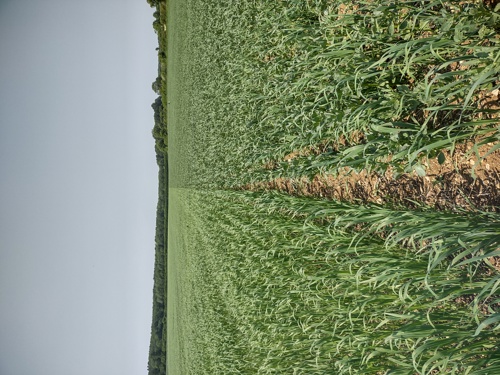
March 2023
2023 growing season
June 2023
August 2023
October 2023
2024 growing season
August 2024
September 24
April 25
August 2025
Autumn 2025

Soil Association
Bristol / UK-wide
Arable & Soils Advisor at Soil Association, and farmer. I ran the family farm in Devon for 25 years, farming dairy, then organic beef, sheep and arable units with holiday cottage conversions. Former chairman of a local farmer owned co-op grain store, and involved in the grain supply chain nationally.

University of Reading
Reading


