Supported by:


There has been a lot of interest in strip tillage among vegetable growers recently. But although there are clear potential benefits, many are cautious to invest time, effort and money in the practice without reassurance that it can work well, particularly in an organic system.
The triallists are exploring different management techniques as part of a strip till system, and comparing them to their previous practices in terms of inputs, yield and soil health.
Click on the brown/orange banner above for latest activity and other information.
Strip tillage is increasingly being adopted in arable systems as a method of conservation/regenerative tillage. It involves tilling narrow strips into a cover crop, into which the cash crop is then planted or drilled, while leaving the areas between the cultivated strips as undisturbed cover crop / residue.
Field-scale veg growing, particularly in organic systems, traditionally uses fertility building leys, a long rotation, annual ploughing between crops and intensive cultivation of the soil.
Growers are becoming increasingly interested in how min-till innovations from regenerative systems could also benefit horticulture rotations by reducing the reliance on annual ploughing and increasing the use of cover crops. One of the main challenges is how to manage the cover crop to prevent it impacting on the cash crop without the use of herbicides.
This is a three-year field lab taking place on three farms, and a fourth grower at a market garden scale. Each farm will compare a vegetable crop grown using the conventional cultivation method at that farm (e.g. plough & power harrowing for field preparation) with the same vegetable crop grown using strip till cultivation. The plots will be either within the same field where possible, or adjacent fields.
Each farm will grow two vegetable crops and two strip till cover crops each year. In the autumn of year one some of the farms will sow their living mulch.
We are heading into the final stages of the field lab, as the end of October sees trialist Jake Harris harvesting his trial plots, comparing yields across different varieties and different variables. The harvesting of one trial plot has been delayed due to the dry weather.
An overview of the harvestable plants on first pick across three variables:
|
|
Mamba Kale |
Raven Kale |
|
Control |
100 |
220 |
|
Strip till |
80 |
200 |
|
Strip till + compost extract |
100 |
200 |
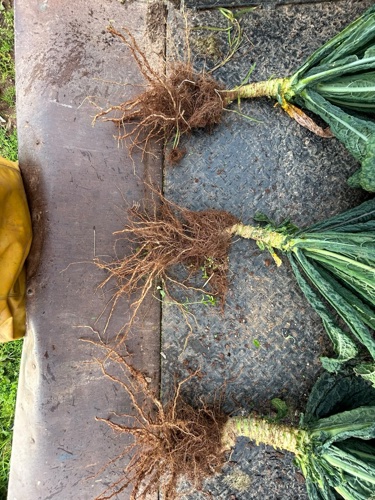
Comparing kale plant root structures across three different plots: Left side is strip till, middle is strip till + compost extract and right is control deep cultivated. More fine roots can be seen on the strip till plant, with the middle having the most indicating good local moisture and nutrient availability. The larger tap root on the right might indicate less local moisture so the plant had to search for it.
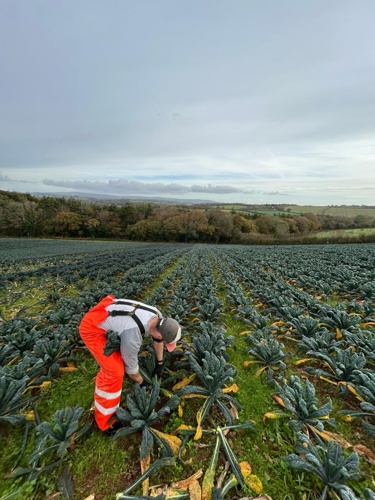
Harvesting kale and measuring yield
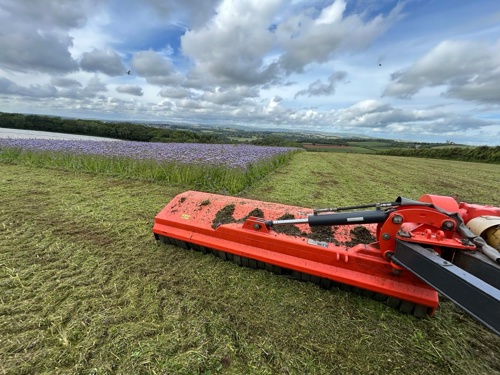
Flail mowing the phacelia cover crop to shallow incorporate with rotovator
Coordinator Hugh and Researcher Francis will be conducting interviews with those farmers that have not been able to continue with the trial, to capture their insights, observations and learnings. A full report including these inputs, and trial results from Jakes plots, will be available at the end of this year.
We asked Jake for his thoughts on the latest:
“Currently we are picking our middle blocks of kale, everything delayed by 2-4 weeks. We didn’t irrigate anything but have applied our vermicompost liquid that we produce here on site to most blocks. The bulk of plants are doing well especially ones that got to 8-10” before it got very hot. Plants that went in towards the end of the summer have failed and earliest plants that went in mid-April also struggled on yield but did harvest.
We’re finding more yellowing on old leaves on all plants so harvesting is slower. Caterpillar damage is not as high as we thought mid-summer and appears lower on strip till plots. This is why we only picked two of the three plots to keep consistency. Overall reduced yield from last year even though the ground held moisture in the strips well and the actual day temps were so high that plants struggled. However they don’t appear to be stunted and are growing to maturity well.”
The strip tillage in horticulture group met online last week to discuss some general observations from the previous year's trail.
Some crop failures in the strip till
On a couple of farms the strip till crops didnt do so well as the ploughed / rotivated plots. In these strip tilled plots the crops never took off, and two farms lost substantial amounts of their broad bean and courgette plants. The triallists are keen to understand why. On one of the sites the on two farms a whole crop of beans and mostly failed except for a few leeks. Broad beans came to nothing. Lack of P & N?
Soil stability
Although the strip tilled crops did well at some of the trial farms, they were not a success at one of them. However, it was noted that the strip tilling had a very beneficial impact on the soil itself. An extreme rain storm took place soon after planting, and the soil in the ploughed plots very soon started washing downhill, whereas the strip tilled plot maintained its soil structure despite the severity of the rain.
Observations on the living mulch

Beans and Living mulch at Andy Dibben's trial site

Courgettes between strips of living mulch
Take a look at Jake Harris' trial films on cover crops and strip till on the knowledge hub.
May 2023
May 2023
Spring & summer 2023
Sep 2023
Spring 24
Spring & summer 2024
November 2024
Spring 2025
spring & summer 2025
Winter 2025

Soil Association
Bristol
Carolyn brings vast knowledge and practical experience of growing produce for the retail and wholesale markets to the team. This combined with experience in estate management for a mixed organic farming business whilst managing the implementation of agri-environmental schemes. Carolyn has a BSc(Hons) Environmental Management and is BASIS/FACTS qualified. She has a keen interest in improving the farmed environment to produce sustainable produce suited to changing market demands.
With a passion for home grown produce and foraged ingredients Carolyn enjoys creating new recipes and sharing them with family and friends all whilst walking the dogs and enjoying putting one foot in front of the other anywhere in the country.

Newton Downs Farm
Devon

South Devon

Shillingford Organics
Exeter

Abbey Home Farm
Cirencester

The Centre for Agroecology, Water and Resilience
Coventry


