Supported by:

In this two year field lab Diarmid Baird, an organic farmer near Dundee, will trial his purpose-built prototype crimper roller to control bracken on his farm and monitor the environmental impacts.
The project compliments and adds value to the field lab exploring nonchemical management of bracken with livestock. This additional aspect explores an innovative mechanical option that could have applications across agricultural, forestry and conservation land. Discussion and knowledge exchange will be done collaboratively with both groups. Robin Pakeman of James Hutton Institute will carry out the researcher role for both field labs, and Tabitha Acton of the Soil Association will coordinate both trials.
Diarmid’s development of his crimping roller has gathered support from industry stakeholders including The Bracken Control group and Forestry Scotland.
For updates please click on the brown banner above.
Bracken can have a major impact on farming businesses, and can be a considerable burden across the managed national landscapes. Left unmanaged, bracken can spread across grazing land and outcompete important ground flora. However, bracken is also a valuable habitat for invertebrates, reptiles, small mammals and some moorland birds. Therefore, part of the work seeks to understand how management affects biodiversity on the site.
Methods of bracken control are varied and include cutting, pulling, rolling and grazing or broadcast feeding for trampling. Many farmers also used a Asulox which until recently was approved annually as part of an emergency authorisation process for use in bracken control. Asulox posed potential risks to the environment and human health, and is no longer available.
The proposed field lab is to use a purpose-built crimper roller as a mechanical method of control. The method of crimping works by pressing a blunt metal blade along the length of the stem of the plant without cutting it. This damages the vascular system of the plant essentially 'bleeding' and slowly dehydrating it.
Following the same survey protocol as the current Bracken Field Lab [insert link], environmental outcomes of this management method will be analysed compared to a control site. This will provide additional data/comparisons for the ongoing field lab as well as providing insight into the impact and effectiveness of this innovative management technique.
The tractor and crimper will be used on a south facing slope. The machine will make around 10 passes on a small slope around 100m long and 3m wide.
Bracken measurement: The bracken growth/ regrowth will be monitored using fixed point photography and drone footage. Bracken height and density (stems within a quadrat) will also be measured.
Biodiversity surveys will be carried out to record the vegetation present within a quadrat.
Soil: Soil structure will be assessed using VESS (Visual Evaluation of Soil Structure) at both the treatment and control sites. Soil samples will be carried out and analysed using NRM Carbon check plus.
Management cost/benefit: Diarmid will monitor and assess the practical and time implications of the using the crimping roller.
Watch the video of the non-chemical bracken management webinar for news from the bracken field labs, tips on bracken control and information on the new Bracken Management Learning Network.
This field lab is all about trialling a crimper roller which was designed to terminate cover crops in American organic systems. Diarmid Baird thought it might do a good job with bracken, which it turns out it does...!
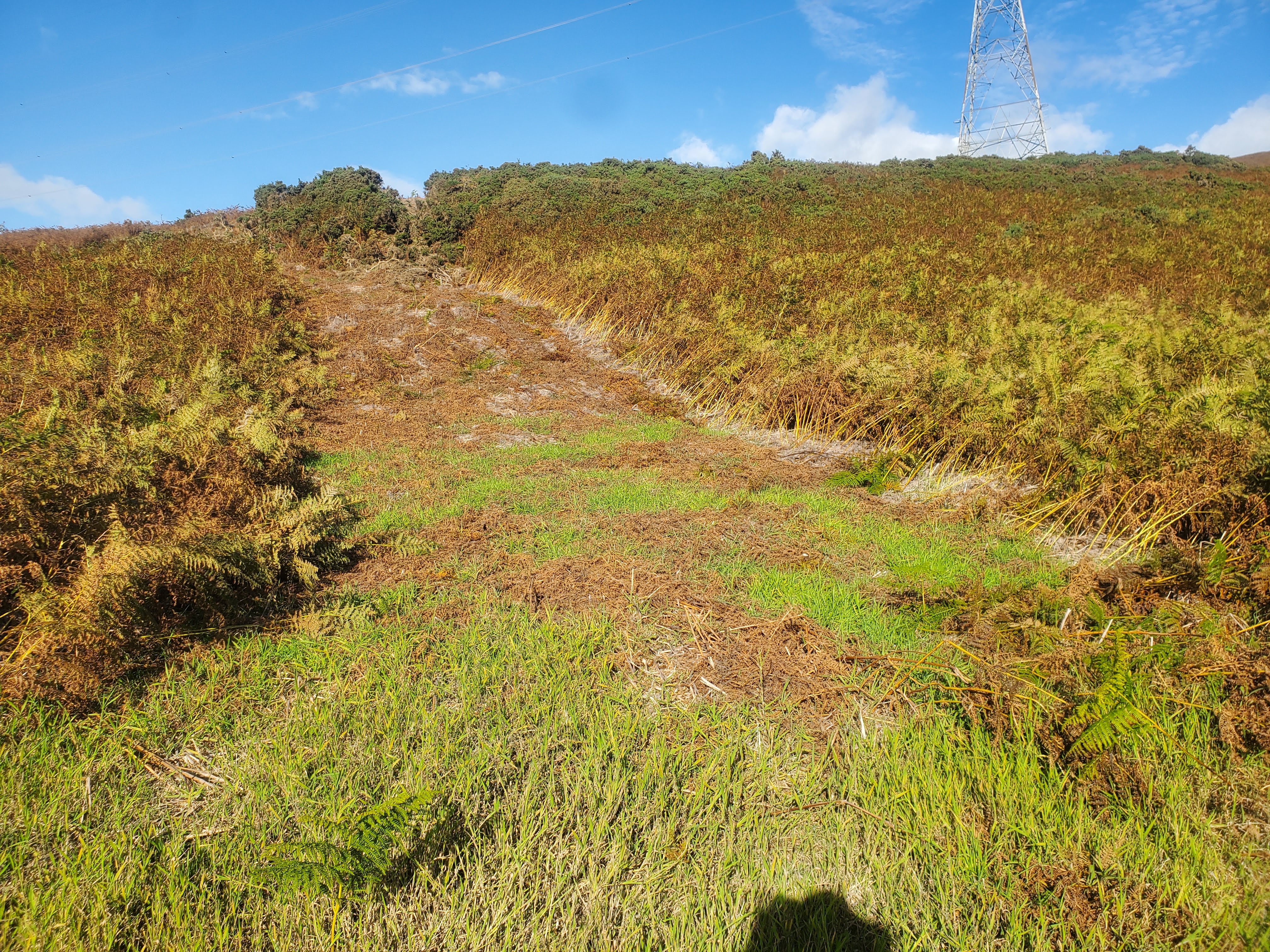
This grass area was first rolled with a front press for a drill four years ago, single pass. In subsequent years, it was rolled with a crimper roller with an ordinary tractor, followed by a crimper with crawler tractor without additional weights. This June, the area was rolled again using a crawler with weights, and the hydraulics set to neutral.
You can see drone footage of the treated area in this video, taken by Diarmid.
Photos were taken at the end of September 2025, and reflect current field conditions. Photo credit: Diarmid Baird, Farmer (2025)

In this video you can see the strip which was crimped one month later than the strip in the photograph above and achieved a more complete kill compared to the June treatment.

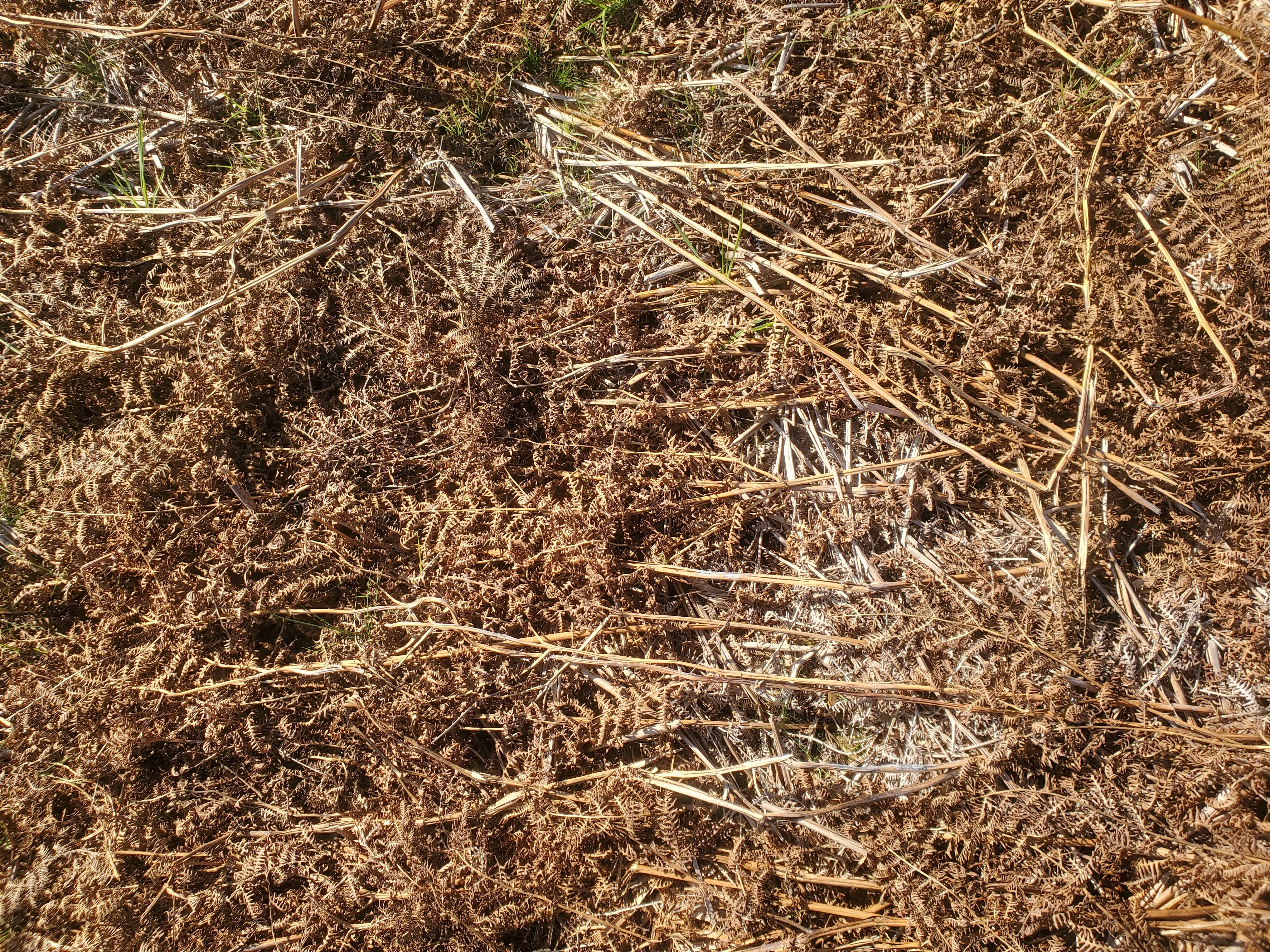
Close-up images of the ground show the crimper roller’s action: it bruises but does not sever the stems, approximately every 100mm. This technique promotes the breakdown of bracken litter and supports the regrowth of grasses. Wildflowers have also begun to emerge in the treated areas.
All photos were taken at the end of September 2025, and reflect current field conditions. Photo credit: Diarmid Baird, Farmer (2025)
June 2025
June / July 2025
June / July 2026
Winter 2026/27

Soil Associaiton
North England
Elly Archer is a farming advisor with the Soil Association’s Farming and Land Use Team, specialising in nature friendly land management. She has a background in integrating pasture and woodland into grazing systems in the North of England. Alongside her advisory work, Elly manages her own 100 acre certified organic holding, bringing practical insight to collaborative projects that support resilient, sustainable farming. Her academic background is in environmental science and management and peatland research.

James Hutton Institute
NE Scotland
