Using gypsum to improve soil health, water quality and fertiliser use efficiency
This field lab will explore the effect of liquid gypsum applications on nitrogen fertiliser use efficiency, soil health and water quality in the south Norfolk and north Suffolk ‘Claylands’ landscape.
The trial was inspired by the results of water quality monitoring, carried out at a number of arable farms in the Waveney Farming Cluster. These showed that nitrate leaching from arable field drains can be a significant ecological and economic problem over winter costing up to £1 per hectare per day in the value of lost nitrogen.
Coordinated by the River Waveney Trust, with Farm Carbon Toolkit as researchers, trials will be hosted on ten farms across ten fields within the Waveney Farming Cluster.
For updates on the trial, trial design and reports click on the brown/orange banner above.
How it works
- Nitrate and phosphate pollution from agriculture is a major cause of poor river water quality, and of economic importance to farm businesses.
- Nutrient leaching from arable fields is linked to soil health and fertiliser use efficiency.
- Gypsum is known to increase soil porosity, structural stability, workability, root exploration and drainage, but little is understood on how gypsum could be used as a tool to mitigate nutrient leaching from non-sodic, heavy clay soils in a UK context.
- In theory, gypsum should:
- Improve root system establishment, leading to increased nutrient uptake
- Reduce surface runoff through improved infiltration
- Reduce soil erosion by binding soluble nutrients in the soil
Trial design
The trial will be carried out on ten trial fields across 10 farms. Each field will be split into control and trial areas. Crop and field management will be identical in the control and trial plots in each field, except for the application of gypsum to the trial plots.
- Preliminary soil testing and soil health checks will be carried out on each field to inform gypsum application rate.
- Liquid gypsum will be applied post harvest 2024 and 2025 to the trial plots.
- Water and N testing (with chlorophyll meter) will be carried out on the fields over winter and spring both years of the trial
- Grain testing will be carried out at both harvests and will calculate fertiliser use efficiency
- Post application soil testing and soil health checks will be carried out on each field to evaluate the impact of gypsum on soil health.
Photo credit Emily Winter
Presentation of trial updates to the cluster group in December 2025
An update on the progress of the Liquid Gypsum trial so far, presented to the cluster group in December 2025.
In the presentation you can find information on the background of the trial, progress so far, NUE data from grain samples, as well as an analysis from Farm Carbon Toolkit on soil data, most recent sampling in November 2025, predicted impacts of gypsum on soil health and comparative results so far.
Cluster Group Trial Presentation December 2026
update
The second applications of gypsum have largely been made.
Farm Carbon Toolkit are gearing up to come out in October/early November to complete the post-application soil assessments
Grain sample results should be back soon, so the group can start to draw up preliminary results from year 1. Year 2 data will be needed to make some full conclusions.
Spring round-up
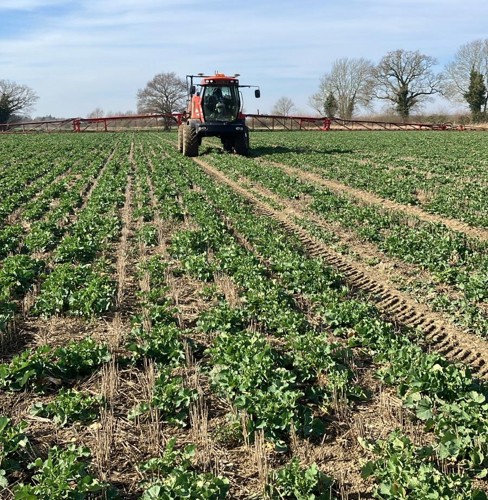
Spring gypsum applications took place between 19th February and 19th April on arable fields growing winter cash crops (winter wheat and OSR). Gypsum applications took place between 27th March and 2nd June on arable fields entered into agri-environment schemes, with one field still yet to receive gypsum (as of 24th June).
N-testing took place weekly on three fields growing winter wheat between 24th March and 2nd June to measure crop nutrient uptake. N-testing uses a handheld chlorophyll meter from Yara to scan growing leaves, measuring light absorbance of the leaf to calculate chlorophyll content and, thus, nitrogen content.
Measurements were taken from control (no gypsum) and trial (gypsum applied) plots in each field for comparison. For two of the fields, N-tester values did not differ substantially between control and trial plots. For the remaining field, N-tester values were consistently higher in the control plot than the trial plot, suggesting better crop growth in the control plot. While this could reflect a negative impact of the gypsum, it is more likely caused by variation in crop growth throughout the field that was already present before the application of gypsum (see satellite imagery).
During this spring growth period, Yara’s software was also used to explore satellite imagery measuring plant biomass across all fields in the trial. It was hypothesised that control plots would be visible due to poorer crop growth compared to trial areas, however there was no obvious visible difference in any of the fields.
In conclusion, there is not yet any evidence to suggest a positive impact of gypsum application on crop growth, however further gypsum applications are planned for later summer/early autumn (after harvest) on the same fields.
Gypsum is most effective when applied directly to the soil during cultivations or at the point of drilling, therefore it’s possible that spring applications on growing crops this year may have compromised its effectiveness, especially considering the recent dry weather.
Post-application soil health assessments are due to be completed in autumn 2025 and will help to provide a definitive assessment of the impact of gypsum.
Spring update
Most of the farms have now applied their gypsum for the spring. A second application will take place in Autumn 2025.
N testing is now taking place on three of the winter wheat fields, and the group are using a chlorophyll meter to check crop nutrition.
The first round of soil assessments took place in autumn (2024), and the second round will take place in Autumn 2025, as will water quality testing.
Trial progress
So far 7 fields have received the gypsum since February, with 3 still to go, dependent on cultivations, crop establishment and grass cuts.
As yet there are no results that positively show the gypsum has affected either crop nutrition or growth, but it is early days.
Gypsum application due
The triallists are preparing to complete their first application of liquid gypsum. The original trial planned for this to take place in the autumn, but wet weather conditions meant that this was delayed until the spring.
The triallists will be using the following application guidelines:
- All rates are 10L/ha, and the product contains 6% calcium and 10% sulphur.
- For spring crops gypsum is best applied to the soil after/during the final cultivation.
- For growing crops the gypsum is best applied to the crop just before, or during, a rain. This sounds counterintuitive, but the aim is that the product be washed off the leaves so it reaches the soil.
- Liquid gypsum should not be mixed with liquid fertilisers, micronutrients in suspension or herbicides. These will all have to be applied in a separate pass.
- The product is highly soluble and at high risk of leaching, so triallists must ensure the weather conditions and soil temperatures are right. As the temperatures warm and biological activity increases an appropriate time to apply should be coming up.
- Gypsum will be applied only to trial plots, not to the control plot. The coordinator will ensure this is carried out correctly.
Soil tests carried out, gypsum delivered
In October the group met online to plan the next stages of the trial. and instruct the farmers on methods and timings of gypsum application. At this meeting a collective decision was made to postpone gypsum application to spring 2025, when its effectiveness will be enhanced due to warming soil temperatures and more active soil biology.
In November initial baseline soil testing for pH, P, K, Mg, Ca was carried out at each of the farmers' trial sites, along with soil health assessments completed by Farm Carbon Toolkit.
Gypsum has been purchased and delivered to facilitator and begun distribution to farmers.
The next step will be application of gypsum in the spring.
Pre-application soil testing and soil health assessments
Aug / Sep 24
First gypsum application
Sep/Oct 24
Continuation of water quality and crop nutrition data collection
Nov 24 - Jun 25
Farm walk / cluster event to discuss progress review and initial results
Jun/Jul 25
Second gypsum applications
Aug-Oct 25
Continuation of water quality and crop nutrition data collection
Nov 25 - Jun 26
Post application soil health assessments
Spring / early summer 26
Final report submitted
Oct 26
Results webinar and public event(s)
Winter 26/27
Group Coordinator

Kat Reay
River Waveney Trust
Kat divides her time between leading the Waveney Farming Cluster and advancing river restoration initiatives. With over five years of experience in environmental conservation, she brings a wealth of expertise from both the charitable sector and the water industry. A devoted wild swimmer, Kat is deeply committed to revitalising rivers and enhancing water quality—not only for the benefit of local wildlife, but also for the communities who depend on these vital ecosystems.
Researchers

Becky Wilson
Farm Carbon Toolkit
South West
Downloadable Reports
Trial Design For The Website
Press articles and blogs
