
Context
There is increasing interest in the practice of using “tall grass” grazing with extended rest periods in grazing rotations to improve soil health, build soil organic matter and increase total forage production. In this field lab six dairy farmers in the South West trialled the practice, in the hope that it would improve degraded pastures without negatively impacting their milk yield. The trial fed into the farmers’ overall strategy of improving their farm resilience in the face of climate volatility.
Trial Design
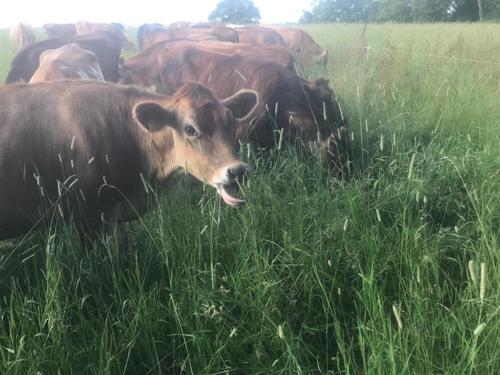
The three-year trial took place on six farms. A control plot, which was managed routinely, was compared with a treatment plot located either next to it or in a similar field.
The treatment management aimed for:
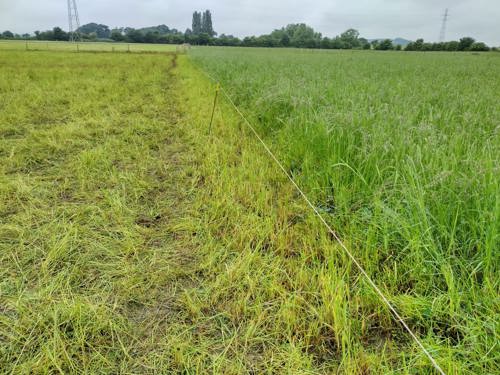
- A higher pre-graze sward (30-50% taller than the control, approx 4500 kg/DM per ha entry cover was the original trial plan), however adjustments were made following challenges in year one, where forage quality dropped to much and so the entry covers in years two and three were lower than this initial target to maintain green leaf stage. However, these varied considerably across farms and it is not possible to give a consistent figure.
- A residual/exit height of >7 cm or 2000-2500 kg/DM per ha
(using a 1/3 eaten, 2/3 residual approach). - Flexible grazing cell division and rotation timing were
permitted, provided the specific entry/exit sward height
protocols are maintained for both plots.
Take Home Messages
The trial has shown that:
- It is possible to improve degraded pastures by using tall grass grazing
- Tall grass grazing does not necessarily always translate into growing more forage on a given area.
- Soil health and forage quality does improve under this grazing regime
- Milk yield did not suffer in this trial.
- Further trials and further investigation of current trial sites would provide more definitive answers.
Findings
- Soil samples taken in 2025 (despite a challenging year in terms of extreme weather) showed a clear advantage in the trial plots.
- Soil moisture and total bacteria and fungi numbers were higher in the trial plots.
- There was some improved soil structure and rooting deeper in the profile of the trial plots.
- The fungi/bacteria ratio was significantly higher in the trial plots by the end of the trial period.
- Forage quality was largely consistent, with the trial plots having slightly higher sugars and dry matter and the controls slightly higher ME, D value and crude protein.
- Macro and micro mineral levels were higher in the trial plot forage, and antagonistic minerals lower.
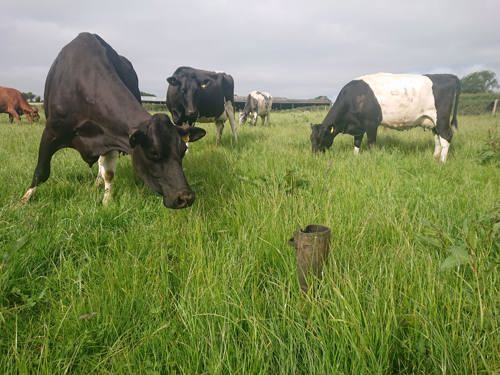
- Some farms grew more forage under the tall grass grazing regime, whereas others struggled to match the control.
Recommendations & Next Steps
All farmers are keen to continue to trial the higher swards, whether that be rolling out the system to more of the grazing platform
or trying it on different fields, such as on aherbal ley over permanent pasture.
For full details of the field lab including the final report, please visit: Does extended pasture resting after grazing improve soil microbiology and soil health?