Is commercial flax production viable for British farmers?
Flax (Linum usitatissimum) was once grown widely across the UK, before the advent of synthetic fibres and cheap overseas labour. A renewed appetite for more sustainable, natural textiles is driving a new wave of flax growing, to supply a sustainable and regenerative textile and fashion industry based on the principles of circularity and social and environmental responsibility.
Since 80% of the world’s flax is grown in Belgium, France, and the Netherlands, there is an opportunity to re-establish commercial production in the UK.
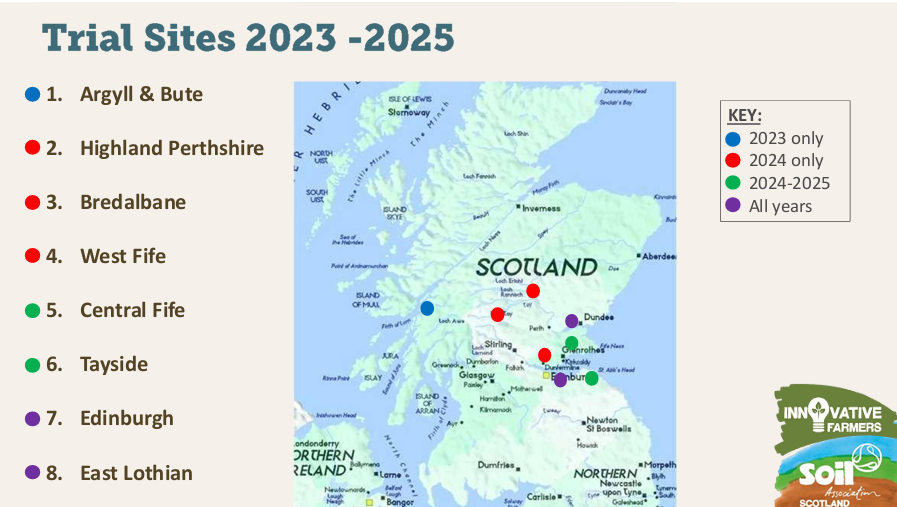
Trial site numbers and locations 2023 - 2025
Trial designed to test three Dutch flax varieties
The field lab started as a one-year trial, but more farmers were keen to join and to collaborate with a growing network of businesses and organisations working to establish a commercially viable Scottish linen processing and supply chain in the longer term.
Eight farms across Scotland took part over three growing seasons (2023–2025), trialling three Dutch fibre flax varieties (Avian, Delta and Tango), to compare straw height (cm) and yield (t/ha). Each site grew 3 replicates of each variety in 10m2 strips, sown in rows. Since the Delta and Tango varieties are not yet commercially available in the UK, the trial aimed to inform wider industry knowledge on their performance in Scottish soils and climate.
The crop was hand harvested before it was fully ripe to obtain the best fibre quality, at which point crop density, height, and weight were measured. The straw was then field-retted and dried for processing.
Plot Layout
Each site grew three replicates of each variety in 10m2 plots, totalling 9 plots per site. To fit in with existing crop beds, plots were arranged in strips, with seed sown in rows 125mm apart (8 rows per metre width) at a rate of 12g/m2 in Year 1, and 15g/m2. Seed was sown either by hand or with a Jang-type seeder between mid-April and mid-May in each year, and harvested between mid-August and early September.
Table 1: Sowing rates were recommended by Elsoms Seeds. TSW = Thousand Seed Weight (g)
| Variety | TSW | Germination | Seed/m | Plot area (m2) | Amount / Plot (g) |
| Avian | 5.9 | 97 | 1200 | 10 | 76.83 |
| Delta | 5.9 | 97 | 1200 | 10 | 76.83 |
| Tango | 6.2 | 97 | 1200 | 10 | 80.74 |
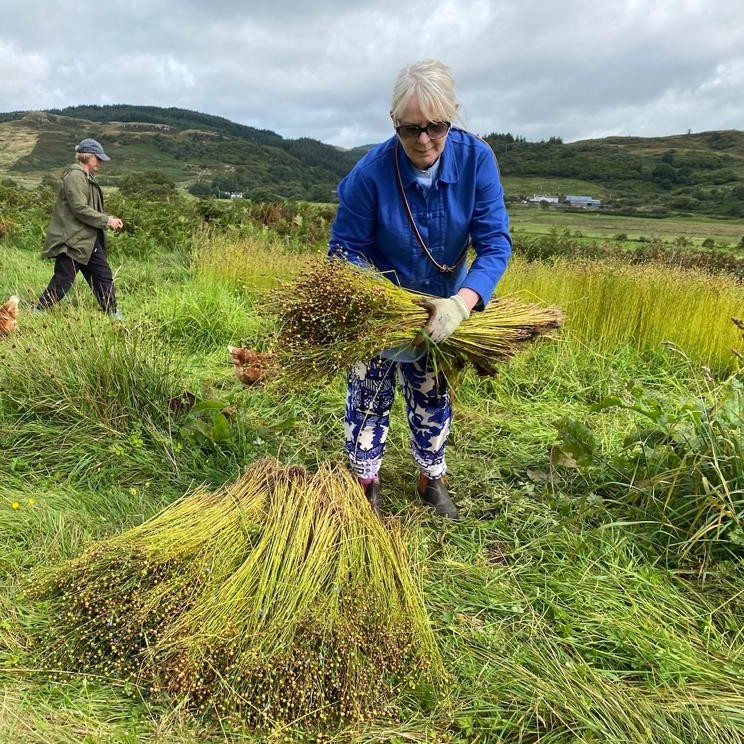
Harvested flax at balruddery
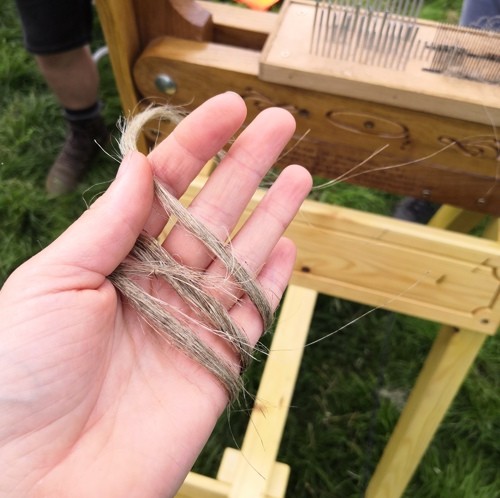
Balruddery processed flax
Harvesting the flax
Fibre flax is typically ready to pull after 100-120 days of growth, which is around 40 days after flowering; when the seed pods have changed from pale green to yellow/brown and the stem has started to yellow. Recommendations from other growers were to harvest at ~100 days; however, triallists found that the crop was not quite ready at this stage so waited an additional 10-17 days before harvesting.
At this stage, the seed heads are not yet fully ripe, but the fibre in the stem is at its most flexible for processing into textile. If over-ripe, the inner fibres start to become brittle, break easily and become more difficult to process. Because there is no commercial flax industry in the UK, there is currently no specialist harvesting equipment available, so the crop was harvested by hand.
Volunteer days were organised to harvest the crop at each site, which provided a valuable opportunity for knowledge and skills sharing, as well as wider engagement with the trial sites and the project. Plants were pulled up by the root to ensure maximum fibre length, and to prevent the fibres deteriorating at the cut end. Pulled bundles were then laid out on bare soil or grass in rows, to begin the retting process.
The lack of access to mechanical harvesting equipment is arguably the biggest barrier to scaling up fibre flax production in the UK, because harvest volume is restricted to what can be hand-harvested.
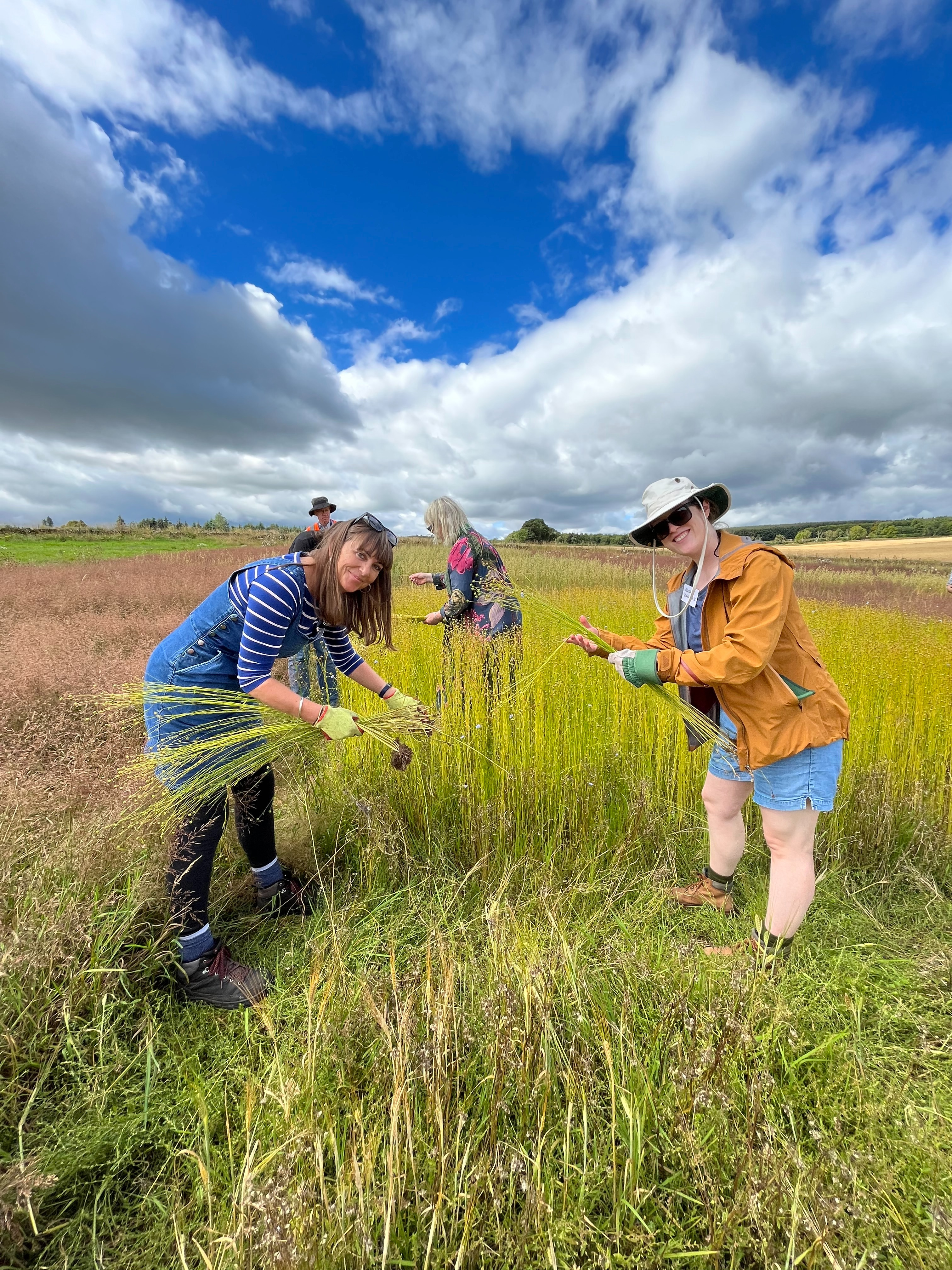
Harvesting flax at Balruddery
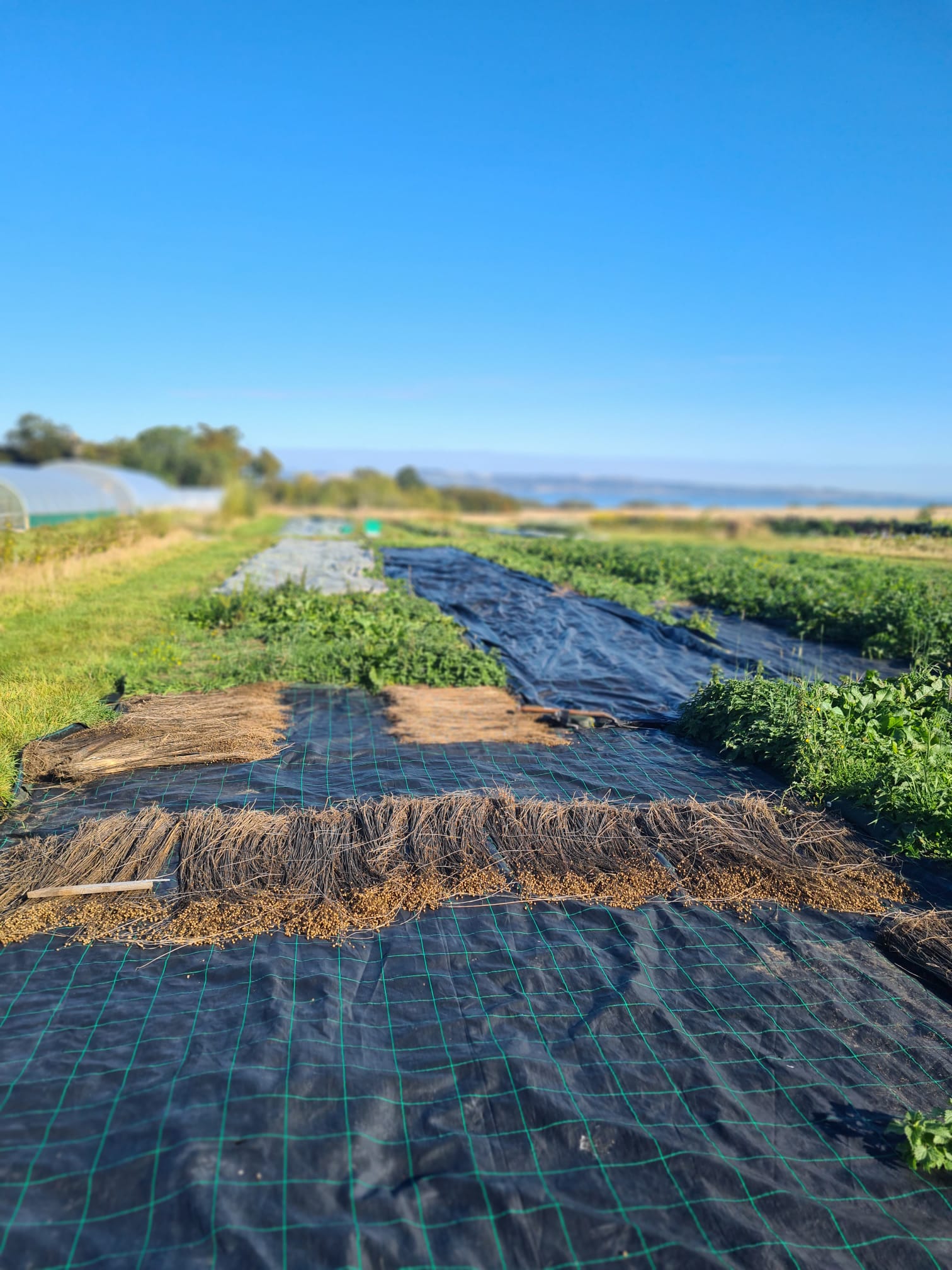
Retting flax at Lauriston Farm
Retting the flax
The process of ‘dew-retting’ involves the pulled crop being lain flat on the soil in rows, with roots at one end and seed pods at the other, for ~3 weeks, and turned halfway through. This is the process by which rainwater and soil microbes in the damp ground break down the lignins and pectins in the woody stem, allowing the flexible fibres to be extracted more easily during processing.
Once retting is complete, the crop is dried and stored for at least two months before it can be processed into yarn. It is also possible to rett the flax in tanks of water (‘tank retting’), but the group decided against this method, as the resultant liquid would be difficult to dispose of safely without causing diffuse pollution.
During the process we learned quickly that there are many variables which influence the speed and evenness of the process, including rainfall, temperature, sunshine, whether it is retting over bare soil or grass - it is an art in itself. Triallists who were involved in multiple years said it was useful to have multi-year experience of the process, to get a better sense of when it was ready to turn, how well-retted it was, when it was ready to dry. More work is needed in this area to be able to maximise fibre quality, as we realised through our triallist and processing partner Fantasy Fibre Mill, that retting has a much bigger impact on fibre quality than the variety.
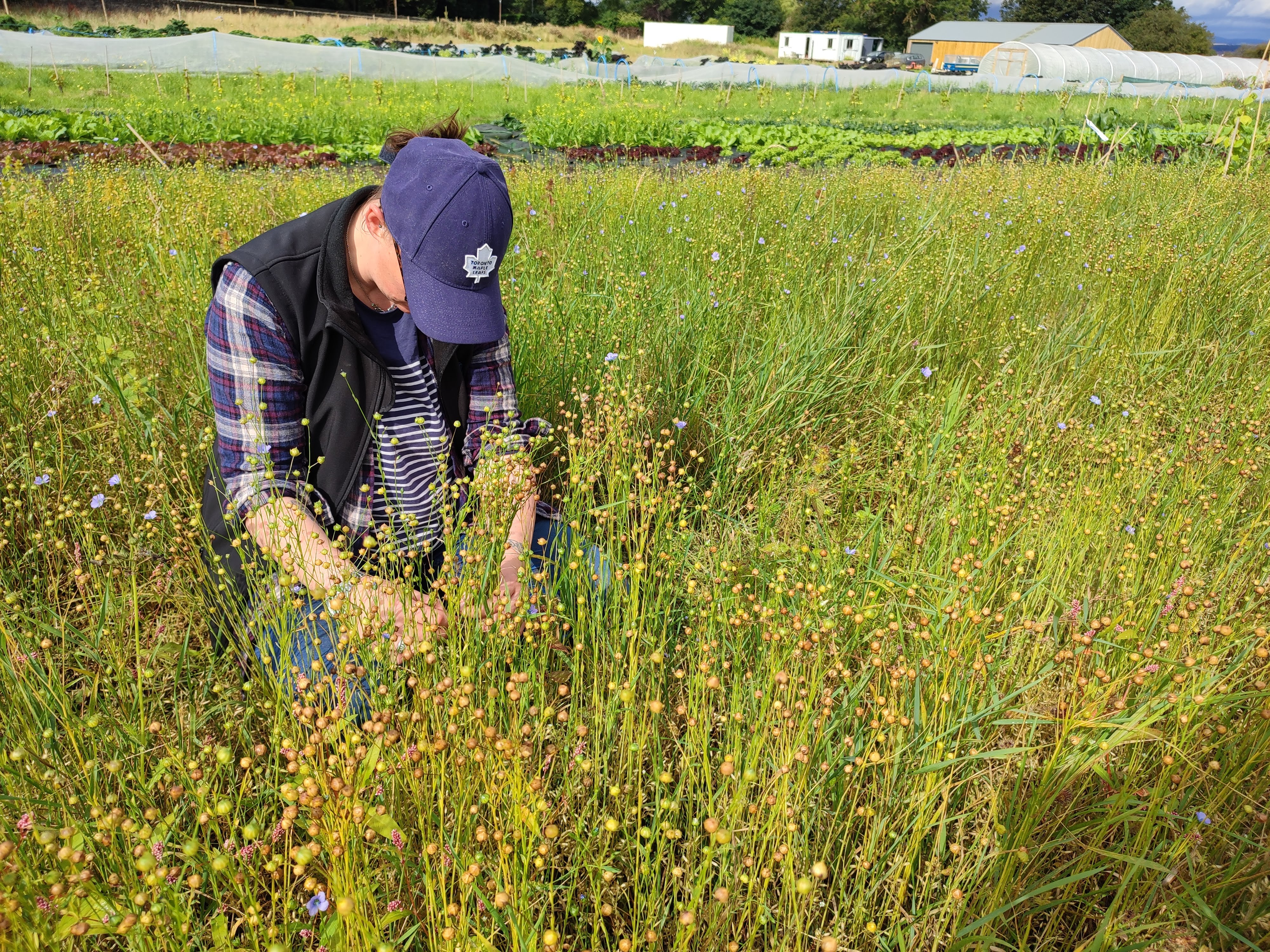
Measuring flax at one of the trial sites
Findings: Farmers are keen to grow flax commercially
All three varieties grew well across all sites and trial years, although yields were variable between years, between sites and even within sites. The biggest influences for this are likely to be weed pressure, differences in soil type and fertility, and weather, such as drought conditions immediately after planting in 2025. There was a correlation between weed burden and both height and yield – weedy plots performed less well. In all cases however, when yield was extrapolated to field scale, it was consistent with or exceeded average commercial yields.
Harvesting was labour-intensive and carried out by hand with help from volunteers, as there is currently no small or mid-scale harvesting machinery available in the UK, which poses a barrier for growth.
Fibre quality was tested for each variety by project partner Fantasy Fibre Mill, and it was found that the degree of retting had more of an impact on quality than variety.
This field lab has also shown that there is a lot of interest, particularly from small and medium sized farms to grow flax commercially, as well as an appetite to collaborate to develop localised short processing and supply chains and tap into direct sales and in some cases workshop delivery.
The trial has highlighted a growing appetite among artisan makers for sustainable UK produced textiles with short/ transparent supply chains. This sits alongside increasing awareness and interest in sustainable fashion and regenerative textiles in consumers, as well as many people wanting to learn how to process the fibre at the individual or community scale.
Learnings from the trial on the future of flax in the UK
This field lab demonstrated that fibre flax can grow successfully in UK conditions and has the potential to become an attractive addition to arable, horticultural and mixed rotations. It offers a diversification option linked to growing demand for sustainable textiles, and yields were comparable to commercial systems, but varied with weeds, soil and weather.
Some of the key barriers to producing flax for textiles is the labour-intensive harvesting required, due to the limited machinery and processing capacity in the UK. The trial found that flax works well at small scale now, but scaling up will depend on developing equipment, seed supply and local processing infrastructure.
Happily, there is a growing network across the UK of people from many different sectors, interested in flax and its uses. There are several projects looking at these same barriers and actively working to address them. Members of the field lab are collaborating with others to build regional farm-scale processing capacity, and to develop a UK supply of non-patented flax seed. Having a supply of non-patented seed means that growers can save seed from their own crop to plant the following year, thereby improving sustainability and resilience.

The trial demonstrates that modern fibre flax varieties can grow well in Scotland, and we know there is growing appetite among farmers, crofters and growers to produce flax as a fibre crop. The next step is to scale up the processing capacity to allow flax to be grown on a bigger scale and harvested mechanically.

Explore the field lab results
You can visit a summary of all the field lab trial activities here.
Download our final report here to read a more in-depth analysis of the trial and the findings.
Watch to find out more about the final results from the field lab, including the different stages of flax seed to finished linen. We explore how a very simple variety trial rapidly evolved into a much wider project to include sowing, retting, seed sourcing, and processing, and went from 4 farm sites to including 30 community plots.
We hear from triallists Jossie Ellis from Lauriston Farm and Rosie Bristow of Phantassie Farm/ Fantasy Fibre Mill (Rosie is processing the flax grown in the trial into yarn), and explore the wider UK and European context with well-known flax grower and designer Zoe Gilbertson. (if you cant view the video you can link to it on Youtube: https://youtu.be/qGgHTpOsX7I?si=q6tg-g9-ZmQav93H)