On farm research is a tricky beast! Each trial starts with enthusiasm and motivation, but can so easily be de-railed by a wide variety of factors. Whilst we try to build risk mitigation into all field lab plans, nobody can plan for all eventualities, and any external problems which impact farming in general can necessarily also affect the viability of trials.
So it has been with this summer's extreme heat and drought, both directly: such as drought leading to poor germination, and indirectly: as farmers (rightly) have to prioritise other aspects of their business over their research.
In this article we focus on a few field labs and ask the farmers how they have coped with the summer.
In some cases new crops were swamped by existing plants with more established root structures, in others there was no germination at all. Organic farmer Dave Oates in SW Cornwall is trialling an on-farm fermented seaweed bio stimulant. The group set up multiple plots for the trial, and in some plots cereals were direct drilled into existing crops. These cereal plants generally struggled to get established due to the drought, with the result that the existing plants with their more established root systems, effectively smothered the cereals due to be monitored as part of the trial. Luckily the group were able to adapt the trial to do replications within the same field.
In addition to the problem of crop establishment, the group have found that leaf rust has been more evident this year. However, in a positive twist, the trial has shown some potential benefits to using the seaweed bio stimulant to control leaf rust which is really exciting.
Germination has been a problem for Ben Andrews in Herefordshire who is trialling under-sowing broccoli with a cover crop mix to protect his soil. Unfortunately, due to 2 months with no rain and no irrigation, the under sown seed mix simply did not germinate, delaying the trial. Fortunately, he has recently seen some green shoots appearing so fingers crossed this has only caused a delay.
Other farmers trialling living mulches under a cash crop have been even less fortunate. One triallist in Devon has had to write off his entire trial this year due to the drought as nothing really grew. One interesting feature of the trial, however, was the reaction of the soil in the extreme heat. The soil temperature of the bare soil in the control plot was 52 degrees Celsius in early summer, whereas in the neighbouring treatment plot (same field) under the clover-based living mulch the soil temperature was just 32 degrees. Studies in Germany have shown that extreme heat can significantly impact soil microbiomes in both cropland and grassland. This result reinforces the real need for trialling living mulches and working out the best way to grow them to protect the soil without impacting yield.
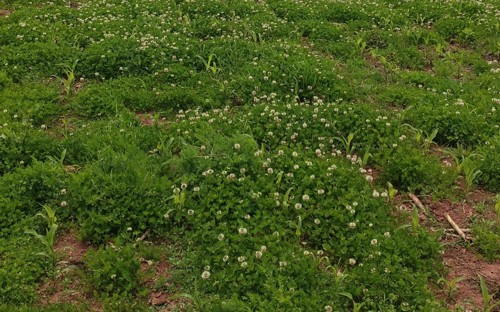
In our heritage grains field lab in Kent the trial aimed to investigate heritage and moderns grains, and their link to soil biota and grain nutrient density. Both sites in Kent suffered from low and varied yields, but at one farm the soil had suffered so much from waterlogging in the winter followed by drought in the summer that there was no soil biota to measure: everything was completely desiccated and dead. We hope to roll over this data collection to next year to obtain some results.
Better news in Scotland as the Bean Variety trial appeared to have been less affected by drought than bean crops in England, according to coordinator Erin Matlock from PGRO, likely because conditions in Scotland were not as dry. These are also winter beans, which seem to have shown greater resilience to dry conditions over the past two seasons.
Drought has affected beans, as it has all crops. However, feedback from farmers across the projects suggests that, in percentage terms, yield reductions in beans have been no worse than those seen in wheat.
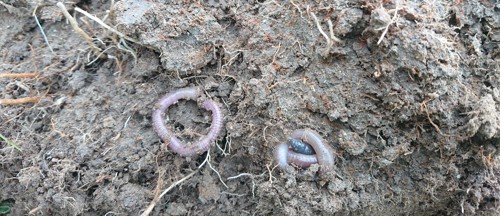
Over in East Anglia Jon Cook is trialling a new method of testing his milk, as part of the raw milk field lab. Located in East Anglia, the farm has suffered severely from reduced grass growth and corresponding drop in milk yields. As a result they're selling almost everything in the tank as soon as they’ve milked it. That has made carrying out meaningful testing for the field lab really difficult, simply because there often isn’t enough milk left in the tank to test. Heat stress has played a part too, so it’s been a pretty extreme summer to be trying to run an on-farm trial.
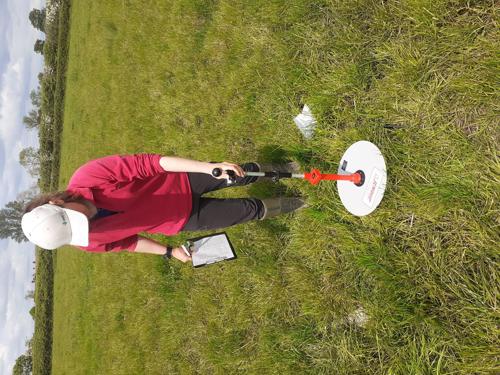
The extreme heat impacted grasslands across south devon, including the field lab investigating the best methods of improving species diversity in existing pastures. Despite strong growth in spring, these habitats quickly burnt off and died back by early/mid summer due to the extreme heat. Many of the wildflowers the farmers had sown withered and died back or set seed very early, flowering for a very short period. This made the survey work harder than a usual year where plants flower for longer and stay green through the summer.
The benefits of trees as shelter for livestock has been starkly evident this year, but has been a huge challenge for those farmers trying to establish trees on farm. The extreme heat caused significant heat stress in new whips planted to create shade and shelter for livestock in the future, and many farmers had to water new whips to prevent them from dying - a huge challenge, particularly at scale. Researcher Robbie Philips said "This highlights the challenge of establishing shade and shelter for future extreme heat when [current conditions] directly impact the ability to create this future shade and shelter already!"
These are just a few issues experienced by the triallists, which have caused irrevocable problems in some trials, and highlighted interesting and unexpected data in others.
Unfortunately we know that climate change is driving these more extreme weather events, and ironically that makes the trials more important than ever. If farmers are able to prove through their trials that they can protect their soils, reduce disease risk or ameliorate heat stress in their animals, then they become a driving force towards more resilient farming.