The latest report on the UK on-farm field trials for the LEGUMINOSE project is now available. While showing mixed results it does reveal useful findings, as well as anecdotal evidence, from the 26 on-farm trials that were planted.
Field lab background
The project is exploring the benefits of intercropping – growing two or more species of crop together, in this case using legumes in the mix. In the field lab, farmers have also explored barriers preventing wider adoption of intercropping, and discovered practical, science-based information in collaboration with researchers.
The research is part of the Horizon Europe LEGUMINOSE project.
Challenging weather conditions
The weather in 2024 and 2025 created some issues with the trials – it was often too wet or too dry. A mix of crops and challenging conditions has made direct comparisons between years difficult, but there have been some interesting results when comparing the combined data from all crops.
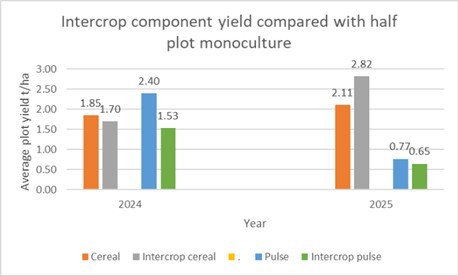
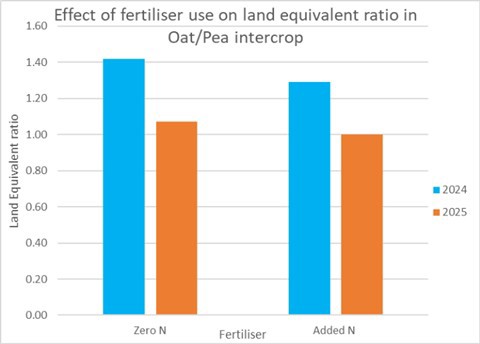
The drought conditions of 2025 put severe pressure on pulse crops, resulting in poor growth, poor pod set and generally short crops with low yields. In comparison, 2024 was very wet, providing good growing conditions for pulses. However, looking at Land Equivalent Ratios (LERs) – which calculate the area of land needed to grow the same quantity, if grown as monocrops – intercrops still outyielded the monocrop yield, although only by 6% in 2025. Comparing the yield of each species in the mix by looking at a half hectare of monocrop with the species’ yield in the intercrop showed one of the benefits of intercrops – more resilience and mutual support in the intercrop when stressed.
Effect of Fertiliser on LER
Another reported benefit of intercrops is higher protein levels in the grain, which is useful for wheat because of its importance in bread making. Results from both UK and European trials did demonstrate an increase, of up to 1.5%, in grain protein and there is evidence that in legume-cereal systems, cereals are typically more competitive for soil N sources. This causes the legume component to compensate by increasing symbiotic atmospheric N fixation, leading to improved nitrogen use efficiency. However, there was also evidence that artificial nitrogen, used to increase cereal yield did result in lower grain protein. It also reduced the crop Land Equivalent Ratio of intercrops.
Intercrops for animal feed
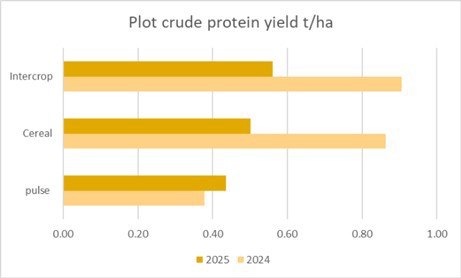
One role for intercrops, particularly on mixed farms, was production of animal feed. From the trial results, intercropped plots produced 20% more protein per ha than a monocrop and 5% more than the cereal plots. Protein quality is an important aspect of livestock feed, and the additional protein would also have been higher quality than a cereal only feed. Intercrop plots produced harvested samples containing 15% crude protein on average, while some individual plots produced samples containing over 20% crude protein.
Impact of drilling system
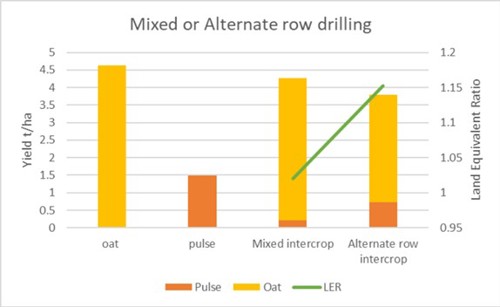
A comparison between planting intercrops mixed in rows, or sown as separate rows, did show a benefit to the pulse in the dry conditions of 2025. This was likely due to less competition for water, although the mixed row crop did yield higher overall. Across LEGUMINOSE’s European trials, it appears that separate rows have been higher yielding.
Effect of intercrops on pests
There was some evidence of reduced numbers of bruchid beetles in intercropped beans. In addition, although trials revealed higher aphid numbers on intercrops, they also showed that populations declined faster in intercrops due to higher predator numbers. In a farm using integrated pest management, intercrops will allow higher pest thresholds before interventions are necessary.
Conclusions
Intercropping has demonstrated an ability to provide more resilience on farms, particularly in low input systems. It can produce higher total yields, higher quality products and more crop protein than monocrops. It can potentially increase resilience and reduce risk.
Find out more about the LEGUMINOSE field lab. Read the full report.
This trial is part of the LEGUMINOSE project which is funded by Horizon Europe with UK funding provided by UKRI. For more information see www.leguminose.eu. Views and opinions expressed are however those of the author(s) only and do not necessarily reflect those of the European Union or European Commission. Neither the European Union nor the granting authorities can be held responsible for them.